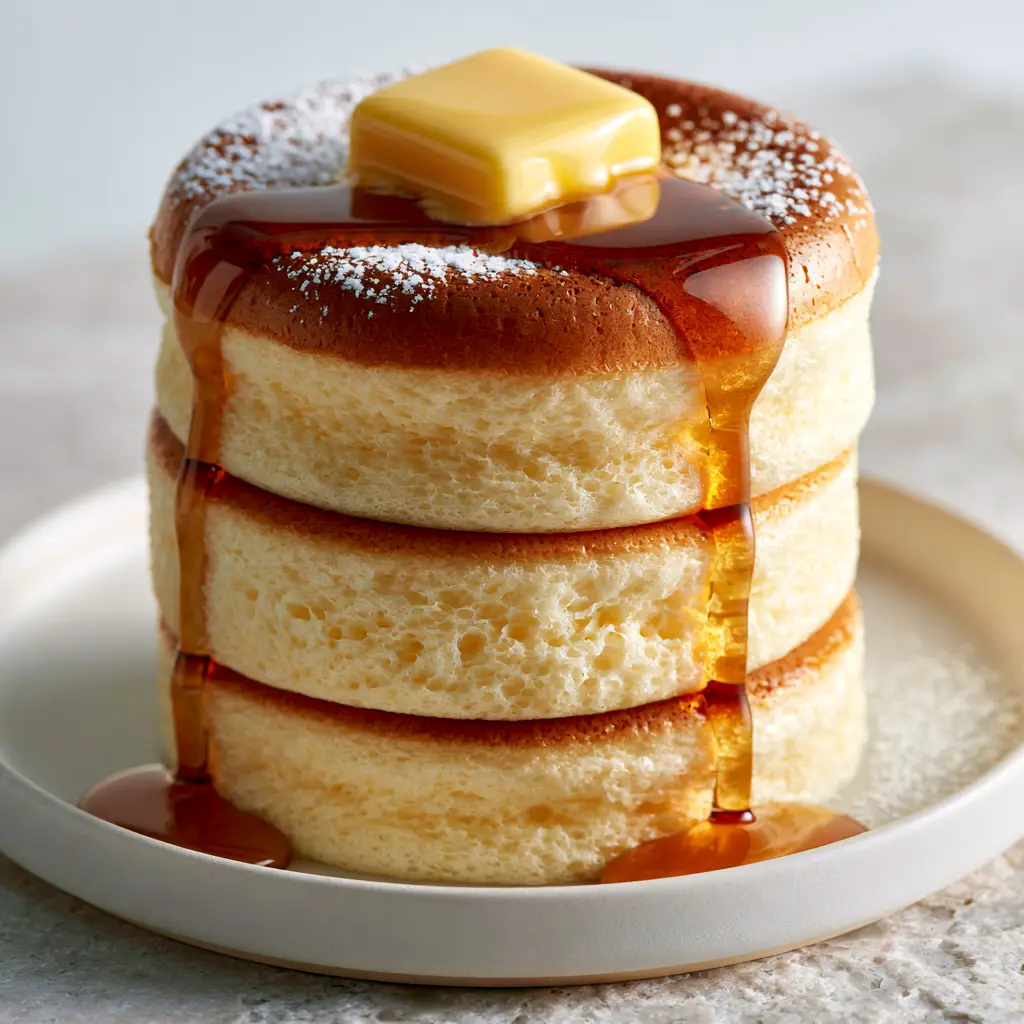
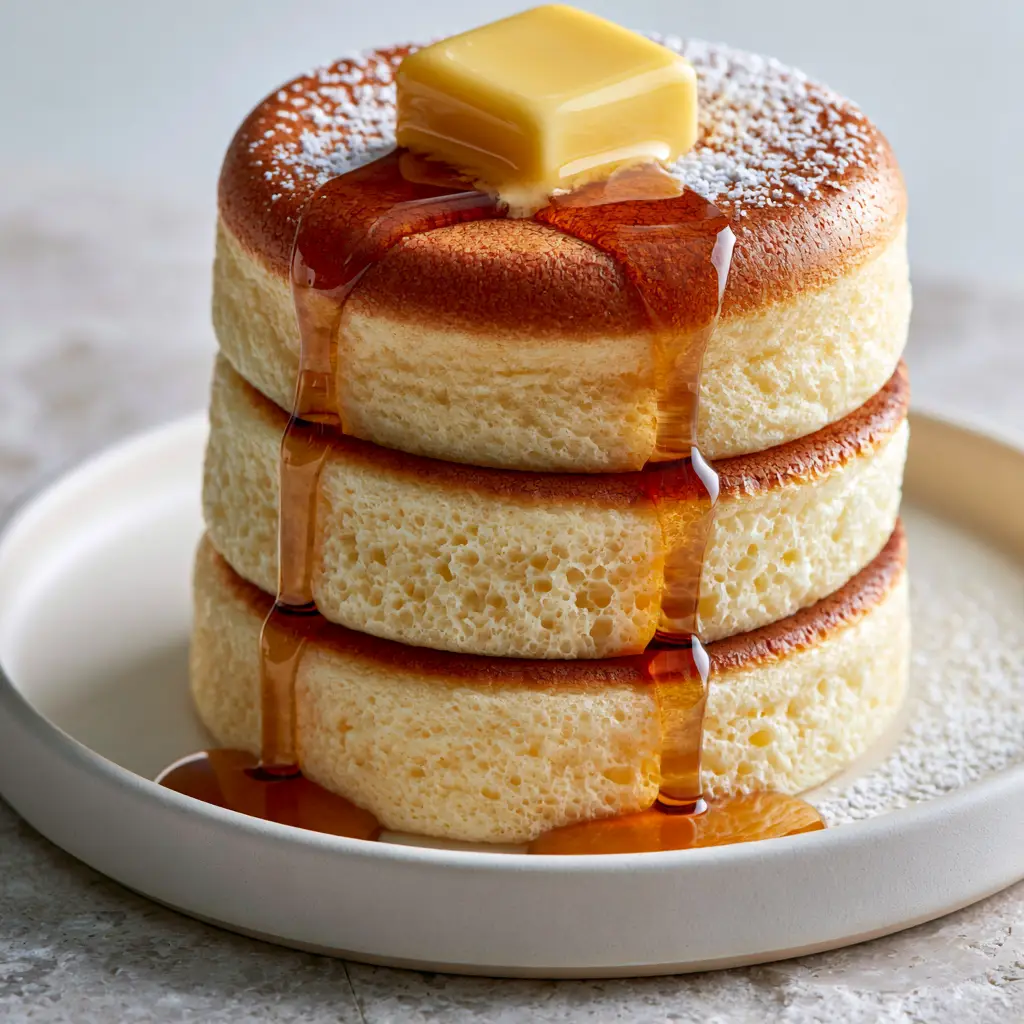
There is nothing quite like the sight of three towering, three-inch-high Japanese soufflé pancakes wobbling precariously on a plate. These aren’t your average breakfast flapjacks; they are architectural marvels of the culinary world, defying gravity with a delicate, sponge-like porous texture that melts the moment it hits your tongue.
When you see that perfectly smooth, golden-brown seared top contrasting against those pale, cream-colored aerated sides, you know you’ve mastered the art. Achieving this level of height and fluffiness requires more than just a standard batter—it’s a precise dance of chemistry and temperature control.
In this guide, we are stripping away the mystery behind those viral café-style treats. We will use forensic culinary techniques to ensure your stack looks exactly like a high-end food blog photo, complete with a melting pat of butter and amber maple syrup cascades.
The Science of the Sky-High Soufflé Rise
The secret to Japanese soufflé pancakes lies in the stabilization of air bubbles. Unlike traditional fluffy pancakes, which rely heavily on chemical leaveners like baking powder, these giants get their lift from a massive volume of whipped egg whites.
By creating a “meringue-style” batter, we trap air in a protein matrix. When that trapped air hits the heat of the pan, it expands, pushing the pancake upward while the flour provides just enough structure to hold that height.
The visual hallmark of this dish is the dual-tone color: a deep golden sear on the top and bottom with a pristine, pale cream color on the thick sides. This is achieved through a combination of dry searing and steam-cooking in a covered pan.
What You Will Experience with These Towering Pancakes
- Unrivaled Texture: A delicate, marshmallow-like interior that is highly aerated and cloud-soft.
- Visual Contrast: A smooth, golden-brown seared crown paired with three inches of pale, porous sides.
- The Perfect Garnish: A single square of melting unsalted butter and a thick, translucent maple syrup drizzle.
- Sophisticated Sweetness: A light dusting of micro-fine powdered sugar that highlights the sponge-like texture.
The Essential Architecture: Ingredients for Success
Large Cold Eggs: You will need 2 large eggs, separated. Cold whites are actually easier to whip into a stable, tight-crumbed meringue which is essential for that 3-inch height.
Cake Flour: Use 1/4 cup (32g) of cake flour. Cake flour has a lower protein content than all-purpose flour, ensuring the pancakes remain tender and don’t become chewy or tough.
Whole Milk: You need 1.5 tbsp (22ml) of milk to create the base yolk paste. This provides the necessary moisture and fat to carry the vanilla and sugar flavors throughout the batter.
Granulated Sugar: Use 2 tbsp (25g) of sugar, added gradually to the whites. Sugar isn’t just for sweetness; it acts as a stabilizer for the egg foam, preventing the “bubbles” from popping too soon.
Cream of Tartar: Just 1/4 tsp (1g) of this acidic powder is the “invisible” ingredient. It strengthens the protein bonds in the egg whites, ensuring your pancakes don’t deflate the moment they leave the pan.
Unsalted Butter & Maple Syrup: One square pat (14g) of butter and 2 tbsp (30ml) of thick amber maple syrup. These provide the iconic “cascading” visual that makes the dish look authentic.
Vanilla Extract & Fine Salt: A dash of each to balance the flavors. Salt is crucial for enhancing the natural sweetness of the maple syrup and powdered sugar.
Tools Required for the Perfect 3-Inch Stack
To achieve the specific result seen in our Midjourney prompt, you cannot simply free-pour this batter. The weight of the meringue would cause it to spread laterally rather than rising vertically.
You will need non-stick ring molds (3 inches wide and 3 inches tall). These act as the “scaffolding” for your pancake as it sets. You also need a heavy-bottomed non-stick skillet with a tight-fitting lid to create the essential steaming environment.
If you enjoy experimenting with different textures, check out our guide on various pancake techniques to see how tools change the final result. For this recipe, a silicone spatula and an electric hand mixer are non-negotiable for folding the meringue.
Step-By-Step: Engineering the Perfect Japanese Soufflé Pancakes
Creating the Silky Yolk Foundation
In a medium bowl, whisk together the 2 egg yolks, 1.5 tbsp (22ml) of milk, and a drop of vanilla extract until pale. Sift in the 1/4 cup (32g) of cake flour and a pinch of salt, whisking gently until a smooth, thick paste forms.
Be careful not to over-whisk at this stage. We want to avoid developing gluten, which would ruin the delicate, aerated texture we are aiming for in the final result.
Whipping the High-Stability Meringue
In a separate, perfectly clean glass bowl, begin whipping the 2 egg whites and 1/4 tsp (1g) of cream of tartar on low speed. Once frothy, gradually add the 2 tbsp (25g) of sugar one teaspoon at a time while increasing the mixer speed.
Continue whipping until you reach “stiff peaks.” You will know you are there when you lift the beaters and the peaks stand straight up without drooping. This is the “engine” that will lift your 3-inch towering pancakes.
The Delicate Folding Process
Take one scoop of the meringue and whisk it vigorously into the yolk paste to lighten it. Then, gently fold the remaining meringue into the yolk mixture using a silicone spatula.
Use a “cut and fold” motion, rotating the bowl as you go. You should stop as soon as no white streaks remain; over-folding will deflate the air and result in flat, rubbery pancakes rather than the sponge-like porous texture we want.
The Steaming and Searing Technique
Lightly grease your ring molds and a non-stick skillet with a tiny bit of neutral oil. Place the molds in the pan over the lowest possible heat setting.
Carefully spoon the batter into the molds, filling them almost to the top. Add 1 tablespoon of water to the empty spaces in the pan (avoiding the batter) and immediately cover with a lid. The steam will cook the pale sides while the bottom develops that golden-brown sear.
Cook for 5-6 minutes per side. When flipping, use a wide spatula to support the mold. The final result should have a perfectly smooth, golden-brown top and bottom with cream-colored, aerated sides.
Expert Tips for a Flawless Breakfast
- Temperature is King: If your pan is too hot, the bottom will burn before the middle sets. Keep the heat at the lowest setting possible.
- Steam is Secret: The tablespoon of water creates a “mini-oven” inside the pan, which is why the sides stay pale and moist.
- Don’t Peek: Every time you lift the lid, heat and steam escape, which can cause the souffle to collapse.
- Freshness Matters: Serve these immediately. Like a traditional souffle, they will naturally lose some height after 5-10 minutes.
Creative Pairings and Serving Ideas
While the classic butter and maple syrup combination is unbeatable, you can expand your breakfast repertoire. These pancakes pair beautifully with a cold glass of triple berry lemonade for a refreshing summer brunch.
If you prefer a more savory-sweet balance, consider serving these alongside a shakshouka toast or even some crispy bacon. For more inspiration on how to elevate your morning meal, browse our unique pancake ideas gallery.
Troubleshooting Your Soufflé Pancakes
If your pancakes are deflating, it usually means the meringue wasn’t whipped to stiff enough peaks or the batter was over-mixed. Ensure your bowl is completely grease-free before starting your egg whites.
If the centers are raw, you likely didn’t use enough steam or the heat was too high, causing the exterior to cook faster than the interior. Patience is the most important ingredient in this recipe!
You can, but the texture will be slightly denser. Cake flour has less protein, which is key to achieving that melt-in-your-mouth, sponge-like porous texture.
While not strictly mandatory for taste, ring molds are essential to achieve the ‘towering’ 3-inch height and clean, pale sides seen in professional café versions.
Cream of tartar acts as a stabilizer for the egg whites. It helps the protein network hold onto air bubbles more effectively, ensuring the pancakes don’t collapse during cooking.
This is intentional! By using a lid and adding a splash of water to the pan, you are steaming the sides while searing the top and bottom, creating that signature dual-tone look.
Deflation is usually caused by an unstable meringue or over-mixing. Ensure you whip your egg whites to stiff peaks and fold them very gently into the yolk paste to preserve air bubbles.
Master the Art of the Japanese Soufflé Pancake
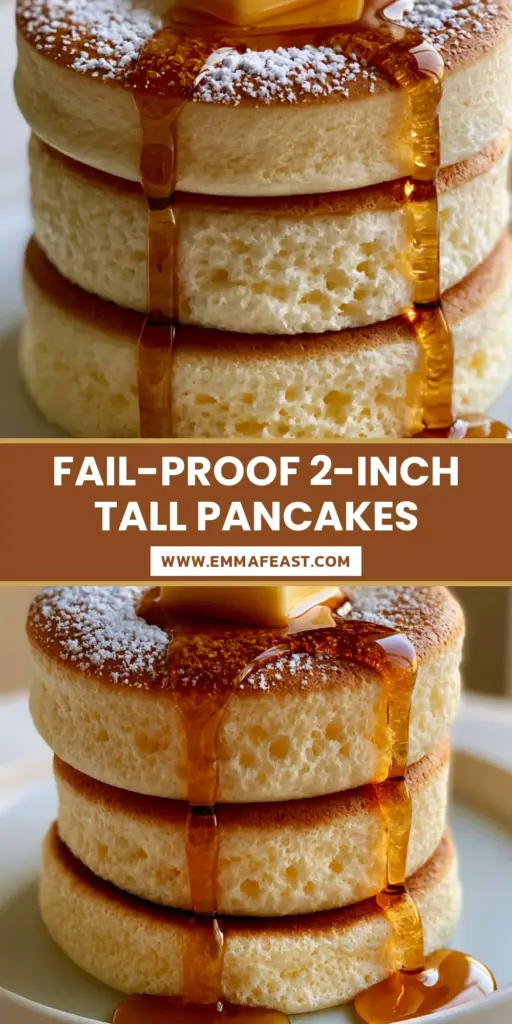
Japanese Soufflé Pancakes: The Ultimate Fluffy Japanese Soufflé Pancakes Recipe
Ingredients
Equipment
Method
- Whisk egg yolks, milk, and vanilla in a medium bowl until combined.
- Sift in cake flour and salt. Whisk until a smooth paste forms, being careful not to overwork.
- Beat egg whites and cream of tartar on low until frothy. Gradually add sugar while increasing speed.
- Continue whipping until stiff, glossy peaks form that stand straight up.
- Gently fold the meringue into the yolk paste in three additions using a silicone spatula.
- Fill molds in a skillet over low heat. Add 1 tbsp water to the pan and cover with a lid for 5-6 minutes per side until golden-brown tops appear.
Notes
Serve immediately to maintain the 3-inch towering height.
Closing & Call to Action
Mastering Japanese soufflé pancakes is a rite of passage for any home cook looking to bring restaurant-quality aesthetics into their kitchen. The combination of that towering 3-inch height and the cloud-like texture makes every bite feel like a special occasion.
If you successfully created this stack, we want to see it! Share your photos and tag us, or leave a comment below with your favorite toppings. Don’t forget to follow emma_feast on Pinterest for more visual recipe blueprints and daily culinary inspiration.